Research in partnership with




About the index
The Australian Resilience Index – the first comprehensive, quantitative assessment of its kind – draws on over 2 million public and proprietary data points to measure the resilience of Australians across health, financial, social and environmental indicators to a local community level.
This data is also categorised by age and gender, providing insights into the challenges faced by demographic groups across different parts of the country.
What we face
Risk
The likelihood and potential severity of an adverse event – such as a natural catastrophe, pandemic or economic shock. Higher risk means greater exposure to harm, but it does not necessarily mean poor outcomes will occur, as this is dependent on resilience.
How we respond
Resilience
The capacity to prepare for, absorb, adapt to and recover from those challenges. A community can face high risk yet remain resilient because it has strong financial buffers, healthcare access, social networks, infrastructure and effective institutions.
Australian Resilience Index
.jpg)

Health Resilience
Data examples
- Rates of physical & mental health conditions
- Access to health care & mental health support
- Consumption of alcohol
- Smoking
- Exercise & diet

.jpg)
Financial Resilience
Data examples
- Income & employment
- Debt
- Access to emergency funds
- Super balances & bank interest
- Insurance penetration
- Reliance on government payments

.jpg)
Social Resilience
Data examples
- Social cohesion
- Crime victimisation rates
- Community activity participation
- Volunteering rates
- Perceptions of belonging
- Confidence voicing political views
.jpg)
Environmental Resilience
Data examples
- Built environment & planning
- Access to emergency services
- Emergency service expenditure
- Information access (e.g. phone & internet coverage)
- Governance & leadership
Public data sources (e.g. Census, ABS, Social Health Atlas)
Proprietary data (e.g. Zurich insurance data, RedBridge/Accent field surveys)
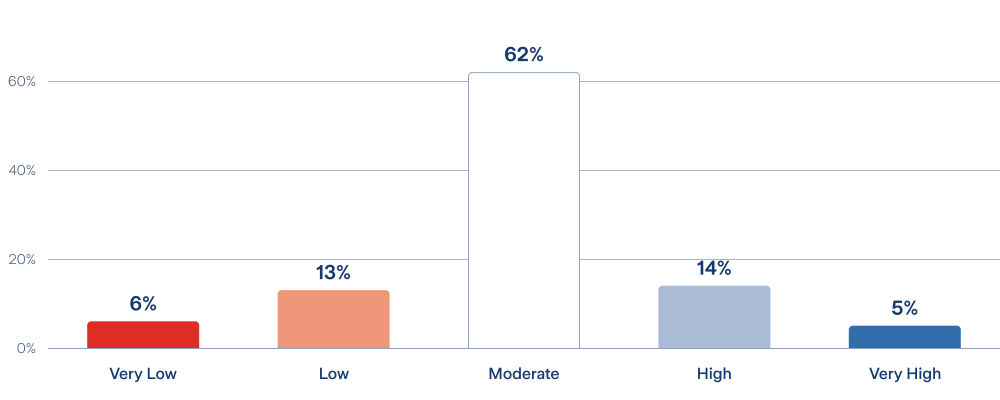
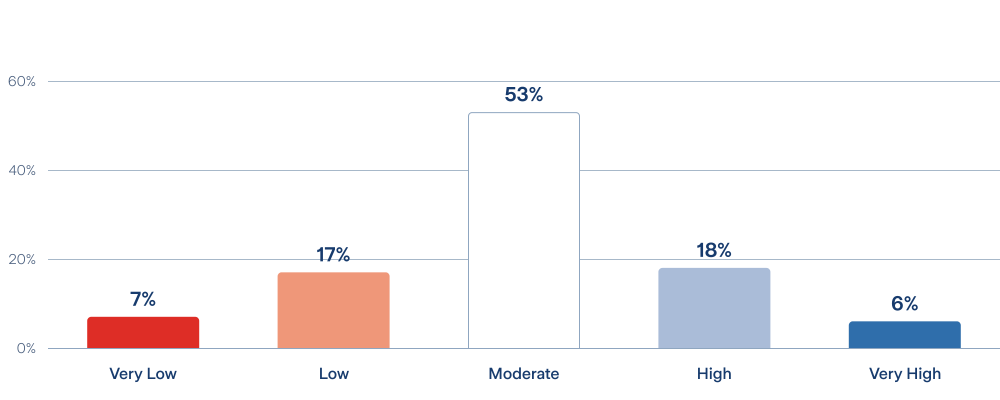
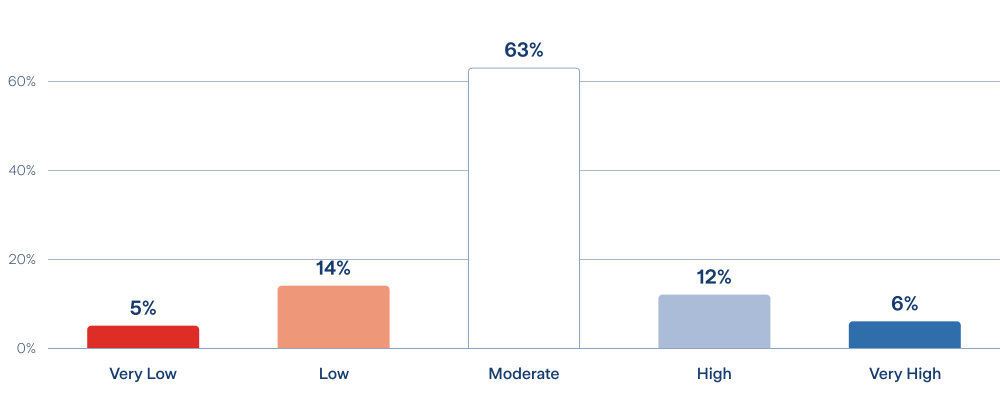
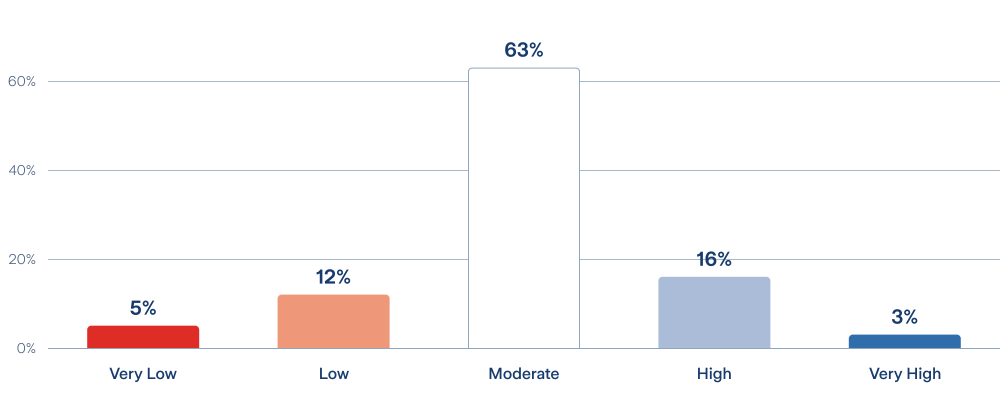
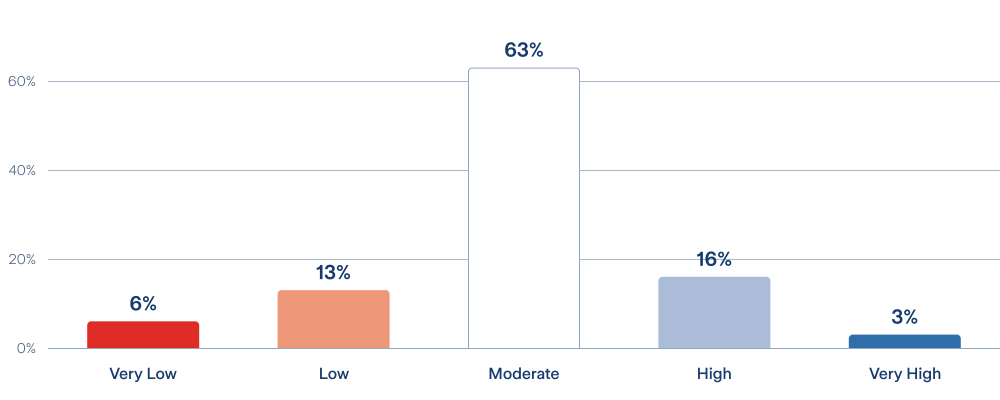
How resilient are Australians?
.svg)
.svg)
.svg)
.svg)
.svg)
Note: due to rounding or incomplete data for some areas, numbers may not sum to 100.
Key insights across each domain
- Financial Resilience has the strongest relationship with Overall Resilience, ahead of Social, Health and Environmental Resilience.
- Among the top decile of SA2 areas for Overall Resilience, 62% of residents have High or Very High Financial Resilience. Among the bottom decile, 75% have Low or Very Low Financial Resilience.
- Australia’s most financially resilient communities have, on average, eight times higher superannuation balances, nine times more dividend income and are approximately three times less likely to lack emergency funds than the least financially resilient communities.
- The ACT has the highest proportion of its population scoring High or Very High for Financial Resilience, at 26%. QLD has the largest proportion scoring Low or Very Low, at 23%.
- Financial Resilience rises sharply with age and is substantially more prevalent among males. This pattern occurs in every Australian state and territory.
- Areas where at least half of residents have insurance are approximately four times more likely to have High or Very High Health Resilience and five times more likely to have High or Very High Financial Resilience than other areas.
- NSW has the highest proportion of its population with High or Very High Health Resilience, at 31%. TAS has the largest proportion scoring Low or Very Low, at 51%.
- Australia’s healthiest communities have approximately 31 times more hospitals within 15km and are 11 times closer to the nearest mental health facility than the least resilient communities.
- Their residents are nearly four times less likely to need assistance with core activities, less than half as likely to smoke and approximately twice as likely to have insurance.
- High or Very High Health Resilience is most prevalent among people aged 15–34, supported by lower obesity, long-term health conditions, smoking and care requirement rates, despite higher rates of mental health conditions.
- Females have stronger Health Resilience overall. Males report almost three times the unhealthy alcohol-consumption rate, 50% higher smoking rates and 24% higher overweight or obesity rates.
- Australia’s most socially resilient communities have approximately almost three times the volunteering rate, 54% lower household crime victimisation, half the proportion of single parents and 37% more community group participation than the least socially resilient communities.
- The ACT has the strongest Social Resilience, with 61% of its population scoring High or Very High. The NT has the largest Low or Very Low share, at 39%.
- Males are approximately 60% more likely than females to have High or Very High Social Resilience.
- Females are approximately four times more likely to be single parents, 30% more likely to feel uncomfortable expressing political views publicly and 27% more likely to report household crime victimisation.
- Males report greater feelings of isolation across every age group, particularly those aged over 35.
- People aged 15–34 are the least likely to have High or Very High Social Resilience. They have approximately half the partner-relationship rate of older Australians, lower volunteering and community participation, and an 83% higher household crime victimisation rate.
- Australia’s most environmentally resilient communities stand apart through stronger governance & leadership, better access to emergency service and high planning & built environment scores.
- VIC has the highest proportion of High or Very High Environmental Resilience, at 30%. The NT has the largest proportion scoring Low or Very Low, at 74%.
- People aged over 34 are more than twice as likely as younger Australians to have High or Very High Environmental Resilience.
- Older Australians benefit from stronger economic capital, community capital and social character, while younger Australians perform substantially better in access to information.
- Males are approximately 2.5 times more likely than females to have High or Very High Environmental Resilience, supported by stronger economic and community capital measures.
Resilience across our States & Territories
Overall resilience
State information
Queensland
Key findings from the Australian Resilience Index.
Overall resilience
Australia’s least and most resilient communities
All rated Very Low for Overall Resilience. Very Low
Tiwi Islands
Northern Territory · Lingiari
East Arnhem
Northern Territory · Lingiari
West Arnhem
Northern Territory · Lingiari
Tanami
Northern Territory · Lingiari
Torres Strait Islands
Queensland · Leichhardt
Northern Peninsula
Queensland · Leichhardt
Halls Creek
Western Australia · Durack
Gulf
Northern Territory · Lingiari
Elizabeth
South Australia · Spence
Ashcroft - Busby - Miller
New South Wales · Werriwa
All rated Very High for Overall Resilience. Very High
Cottesloe
Western Australia · Curtin
Hunters Hill - Woolwich
New South Wales · Bennelong
Toorak
Victoria · Kooyong
City Beach
Western Australia · Curtin
Mosman - South
New South Wales · Warringah
Castle Cove - Northbridge
New South Wales · Bradfield
Rose Bay - Vaucluse - Watsons Bay
New South Wales · Wentworth
Bellevue Hill
New South Wales · Wentworth
Woollahra
New South Wales · Wentworth
Double Bay - Darling Point
New South Wales · Wentworth
The resilience pressures facing generations and genders
37%
score High or Very High for Health Resilience
Young Australians show strong Health Resilience, with 37% scoring High or Very High and only 9% Low or Very Low, despite higher than average rates of mental health conditions. Financial strain is evident through higher renting, housing stress, part-time employment and limited emergency savings.
20%
have Low or Very Low Social Resilience – the sharpest rate of any age group
Middle-aged Australians face the sharpest Low or Very Low Social Resilience rate, at 20% of the population. Approximately 39% report weakened belonging and 48% feel like a stranger in their own country.
3×
more likely than younger and middle-aged Australians combined to have High or Very High Financial Resilience
Older Australians are over three times more likely than younger and middle-aged Australians combined to have High or Very High Financial Resilience. However, 42% have Low or Very Low Health Resilience, compared with 14% among younger age groups, driven by higher obesity, smoking, care needs and long-term condition rates.
3×
Females are more likely than males to have Low or Very Low Overall Resilience
Females are over three times more likely than males to have Low or Very Low Overall Resilience. Around 32% of females fall into the lowest two Financial Resilience categories, compared with 6% of males, driven by higher rates of single-parenting, part-time employment and lower accumulated wealth.


Background & Methodology
The Australian Resilience Index was produced by Zurich, Mandala Partners, RedBridge and Accent Research. It draws upon four individual indexes: health resilience, financial resilience, social resilience and environmental/climate resilience. Each of these indexes use a combination of proprietary and public datasets to quantify the resilience of the Australian population by location (SA2 level, jurisdiction, remoteness and electorate), gender and age. Index values provide a relative ranking for each demographic group, which are then arranged into categories between Very Low and Very High based on this relative ranking.
Zurich Financial Services Australia is a life insurance, commercial insurance and investments specialist that has been participating in the Australian market since 1920. Since its acquisition of OnePath Life from ANZ in 2019, the company provides life insurance to more than 1.5 million Australian customers under both the Zurich and OnePath Life brands. Further information about Zurich Financial Services Australia is available at www.zurich.com.au.
Mandala Partners is an economics research and advisory firm. Mandala specialises in combining cutting-edge data and advanced analytical techniques to generate new insights and fresh perspectives on the challenges facing businesses and governments. More information is available at https://mandalapartners.com/
The RedBridge Group is an Australian political consultancy, research, and public opinion polling firm founded in 2018 by former Victorian Labor strategist Kos Samaras alongside political operatives including Tony Barry. The firm tracks voter behaviour, public sentiment, and national political trends. More information is available at https://redbridgegroup.com.au/
Accent Research combines in-house expertise from political campaigns, data science, academia and advocacy roles, using cutting edge methods to measure attitudes across populations, track public opinion in near real-time, test campaign messaging and identify ways to engage with the community. Accent Research (with RedBridge Group) are the official pollsters of the Australian Financial Review. We are also local leaders in the model-based approach called MRP, providing clients with the most granular insights possible. Our research provides election campaigns with information at the level of individual seats, and organisations working on public policy and corporate campaigns smaller areas, including SA4 regions and postcodes. More information is available at https://www.accent-research.com/